What are the World Pickleball Rankings
With 8,000+ tournaments expected to run on PickleballTournaments.com in 2026, we are in the unique position to create a tournament player ranking system that takes into account the vast majority of tournament play in determining how players stack up in their state, region and country.
The World Pickleball Rankings (“WPR”) understands that not all tournaments are created equally. The WPR evaluates every tournament and bracket to determine the competitiveness and awards ranking points based on this. The more competitive the tournament and associated brackets, the more ranking points get awarded.
No matter how big or how small, the tournament results will count towards the World Pickleball Rankings.
Tournament Directors may specify if a bracket should be ignored for ranking purposes. This is typically the case for brackets that are not considered “competitive” in nature (e.g.: parent/child events, etc.).
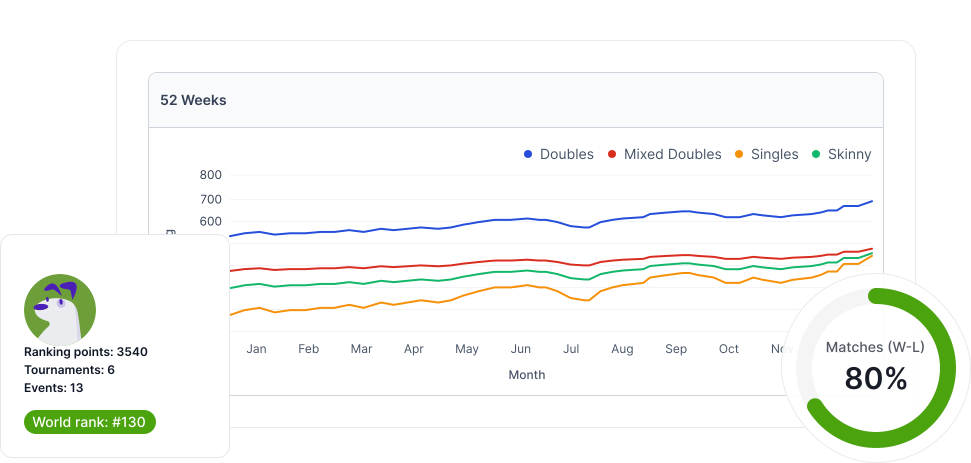
How Player Rankings Work
Let's talk about the key factors that calculate the WPR ranking points:
Minimum 2 Tournaments
To be ranked in the World Pickleball Rankings you must have at least 2 tournaments recorded within the timeframe of the ranking. Players playing in only 1 tournament will not be listed with a ranking.
Top 5 Results
To ensure our World Pickleball Rankings are both fair and accurate, we use a "Top 5 Results" model instead of simply adding up all tournament points. This approach solves a common problem in ranking systems by preventing players from artificially boosting their rank through a large volume of low-point tournament results.
Top 50%
The top 50% of teams/players in a bracket will get ranking points. If a bracket has an odd number of teams/players the 50% will round down. Example: 50% of 9 teams/players is 4.
Size of the bracket
The larger the bracket the more ranking points that bracket can produce.
Bracket Strength (BS)
Bracket Strength is the number of ranking points assigned to a bracket in a tournament. The BS depends on the total count, ratings, and experience of the players in a bracket. Players earn ranking points depending on the bracket value and their performance within a bracket.
BS of a Pure Bracket
Pure brackets include players of the same skill. Example: all players in the bracket are 3.5 (which is a rating of 3.500 to 3.999). If any player is not a rated between 3.500 and 3.999 then the bracket is NOT declared pure, even if a player purposely signs up to play in that bracket. A pure bracket is not based on the setting on the bracket nor their purposeful intent to sign up, it is based on the rating of all the players that played in the bracket.
BS of a Blended Bracket
Blended brackets include players with varying skill (example: 3.5 and 4.0 players in the same bracket). The points given for a blended bracket are based on the average skill of all players in the bracket. Example: If you have a 3.5, 4.0, and 4.5 player in the same bracket the points given would be based on the 4.0 player.NOTE: A blended bracket gives points for each skill represented in the played bracket but merged from another bracket.Example: If a 3.5 bracket was merged into a 4.0 bracket (making a 3.5 to 4.0 Bracket) then the 3.5 subset of players that did not get points from the top 50% may earn points based on a "subset" of 3.5 players. If a 3.5 player registers directly into a 4.0 bracket they will not get points on the subset because they choose to play in the 4.0 bracket.
Tournament Strength (TS)
Tournament Strength is the sum of the bracket values in a tournament. TS represents the overall strength of competition at a tournament. The more brackets there are, the more competitors, and the stronger the competition, the higher the TS.
Reliability Index
This is a measure of a player's bracket skill reliability. The more matches a player plays, and the more recently those matches were played, the higher the reliability index.
What type of matches are included in the World Pickleball Rankings?
In addition to completed matches, we calculate matches that were considered withdrawals, retirements and forfeits. We show tournaments/brackets where the player earned WPR ranking points.
These factors result in the total WPR ranking points to be awarded to players in a bracket. WPR ranking points are then awarded to individual players based on where they finished within the bracket (i.e.: highest WPR ranking points are awarded to the gold medalist, lowest WPR raking points awarded to the last qualifying points paying position).
How Tournament Rankings Work
Let's talk about the key factors that calculate the WPR ranking points:
Tournament WPR ranking
Tournaments completed on PickleballTournaments.com receive a World Pickleball Ranking (WPR). Each tournament's WPR is based off of the calculated Tournament Strength (TS). The higher the TS, the higher ranked the tournament.
How WPR is determined
The #1 WPR tournament is the tournament with the largest TS value (max TS value), with all other tournament rankings descending from this max TS. As noted in the How WPR Works discussion for players.
What is Tournament Strength (TS)
TS is the sum of the Bracket Strength (BS) values for all the brackets in a tournament.
Why some tournaments rank higher
Based on this, tournaments that attract deep brackets of highly competitive players produce TS values in the X+ multiples range above the mean strength of all tournaments.
The range of Tournament Strength values
Given that PickleballTournaments.com hosts a massive range of tournaments, from major international and national level tournaments to charitable round-robin tournaments run at the local park, the maximum TS value and minimum TS value is large (see table below).
Understanding the distribution of Tournament Strength
A statistical analysis of TS values for the total population of tournaments shows a right-skewed distribution with heavy outliers due to the spread of TS values going from max TS descending to min TS and the larger density of small tournaments in the population skewing the mean value for TS much closer to the min TS than the max TS.
Percentile ranking explained
Based on this, the best method for understanding where an individual tournament's TS value falls with the total population is on a percentile rank basis.
Tournament percentile analysis
Using the period of January, 2024 to December of 2024, we can analyze the characteristics of a WPR tournament on a percentile basis. In the following chart we create discrete tiers of tournaments based on their TS (Note tiers exclude previous tiers. As an example, Top 5% excludes Top 1%, etc.).
Tournaments by TS Percentile Rank
Tier insights
The following table provides insights into the characteristics of of each tier:
| Top 1% | Top 5% | Top 10% | Top 25% | Top 50% | Remainder | |
|---|---|---|---|---|---|---|
| Max TS | 505,687 | 88,492 | 35,048 | 22,028 | 8,642 | 3,452 |
| Min TS | 90,099 | 35,100 | 22,172 | 8,644 | 2,453 | 2 |
| Avg TS | 154,929 | 51,594 | 27,759 | 13,461 | 5,436 | 1,390 |
| Max Events | 242 | 105 | 87 | 104 | 54 | 33 |
| Min Events | 17 | 3 | 6 | 1 | 1 | 1 |
| Avg Events | 91 | 41 | 30 | 22 | 15 | 7 |
| Max Players | 3,554 | 1,281 | 1,091 | 615 | 547 | 457 |
| Min Players | 200 | 29 | 56 | 20 | 10 | 5 |
| Avg Players | 1,163 | 495 | 354 | 248 | 160 | 78 |
As you would expect, the TS values for tournaments in the top tiers are a result of a larger number of deep brackets of higher skilled players.
TS values analysis
Another interesting analysis of TS values on a percentile ranking tiers is where the top tournaments are located. If we group the Top 1%, 5% and 10% in a cumulative group, we see the following relative density on an international level and in a drill-down in the United States:
Cumulative Top 10% Tournaments by Country
Cumulative Top 10% Tournaments by U.S. State
WPR Player Status
The World Pickleball Rankings (WPR) isn't just about a number—it's about your status in the global community. As you climb the ladder, you unlock new tiers that reflect your dominance on the court. On your player profile and throughout pickleball.com you will see a badge representing your tier.
Guide to WPR Statuses
- Legend (Top 10): The absolute pinnacle of the sport. To be a Legend is to be among the ten best amateur players on the planet.
- Icon (Top 50): The elite vanguard of pickleball. Icons are the players everyone watches and the ones every opponent fears in a tournament bracket.
- Titan (Top 100): A powerhouse tier for the world's most formidable competitors. Titans have proven they can go head-to-head with the best and consistently come out on top.
- Baller (Top 500): The gold standard of high-level play. Being a Baller means you’ve broken into the upper echelon of the global circuit and are a serious threat in any tournament.
- Contender (Top 1,000): The rising stars and proven winners. Contenders are the top 1,000 players globally who are actively fighting to disrupt the top tiers and make their mark.
- Player (Open): The heartbeat of the sport. Every journey to the Top 10 begins here. Keep playing and competing to improve your status.
Dynamic WPR Status
Your WPR status is dynamic. Because rankings are calculated based on your recent tournament results relative to the rest of the field, you can move up or down tiers weekly. You might be an Icon today, but if you don't defend your points, a hungry Titan might take your spot tomorrow.
WPR Tournament Status
Not all tournaments are created equal. To help players identify the most competitive events in the world, the World Pickleball Rankings (WPR) assigns an official status to every eligible tournament.
Tournament WPR Ranking
When you see a WPR Badge on a tournament page, it represents the event's "Strength of Field." We calculate this dynamically based on several key factors:
- Quality of Field: The average WPR ratings of the registered players.
- Player Volume: The total number of participants competing.
- Bracket Depth: The complexity and skill levels of the individual divisions.
Tournament Status tiers
- WPR Top 1: This badge is awarded to the single most competitive tournament currently on the global schedule.
- WPR Top 50: A premier global event. These tournaments attract the highest concentration of Icons and Legends, offering the most challenging path to the podium.
- WPR Top 100: A major regional powerhouse. These events are known for deep brackets and high-intensity play, serving as a primary battleground for top-tier rankings.
- WPR Top 500: A high-level competitive circuit. These tournaments represent the gold standard of organized play, drawing a strong field of Ballers and seasoned competitors.
- WPR Top 1000: A recognized points-earning event. These tournaments are the foundation of the WPR ecosystem, perfect for Contenders looking to climb the global ladder.
Why Tournament Status matters
Tournament Status gives you a clear indication of the competition you'll face. Winning a Top 50 tournament carries significant prestige and is a major indicator of a player's ability to compete at the highest level of the sport.